Sunday, 1 June 2014

He Came Closer

He Came Closer
by Rachel Lysenko
On Sunday, the day before Halloween, Lily walked out of her house and saw a boy strolling down the street. Deciding to ignore him, she took out a rake and started to rake the leaves out of the driveway, as she did every morning in autumn after a windy night. The boy kept coming onwards in the direction of Lily’s house but only looked at her house when he turned and stopped in her driveway.
What do you want?” asked Lily. The boy did not reply but started staring at her instead of at the house, with an expression as inanimate as a mask.
Why are you here, what do you want?” she asked and again received no answer. Freaked out, Lily went inside and stayed there the whole day doing her homework.
The next day, Lily woke up thinking about school and candy. The moment she opened the door, she closed it back up and locked it. The boy was a few steps closer to the house then she remembered.
Mom,” said Lily. “There is someone outside on our driveway.”
Go to school Lily,” said her mother in a tired voice. “You’ll be late.”
Frightened but obedient, Lily walked out onto her lawn and locked the door from the outside. Something she had never done before. Inching her way as close to the wall as possible, Lily passed the boy and ran the rest of the way to school.
After school, Lily came home and shrieked when she saw the boy. She had forgotten he was there. Coming in the same way as she had left, she locked the door again and called her mother who did not answer.
Hi Mom, the boy is still there. When are you coming home? I am freaked out. Call me back as fast as you can,” Lily said after the beep that allowed you to leave a voice mail.
Her mother did not come home that night or the next. For three days Lily waited and watched the boy come closer and closer to her door.
On the third day, Lily unlocked her door to look outside but thought better of it and looked out the window. The boy was really close and had his hand half raised as if reaching out for something. Lily walked out the back door and locked it as she did every day with the front one.

After school, Lily came home and saw her mother inside hugging the boy who was staring out her window. He went outside and Lily grabbed for him, but her hand went through him. She saw herself turning into mist as the boy smiled and said, “Good bye.”

Wednesday, 9 April 2014

Room Number Three by Julie Xiao

Writing Grade 7-8

The dream always ends with the nurse from the morgue saying, “Room for one more darling.”

Isabelle awakes, gasping for air. Tigger meows from the foot of her bed, staring at her.

“How are we doing today, Miss Holloway?” Doctor Scholl asks.

“I had the dream again. Only I don’t think it’s a dream anymore, it’s real!”

“Don’t be silly. This is a symptom of stress, nightmares and disturbing dreams,” he soothes. 

“Now, you have a visitor today.”

“Really? Who?”

“Your agent, Jimmy.”

A round man walks into the room with a smile like the Cheshire cat’s. Isabelle shrieks and the two quickly fall into a conversation. Near the end of visiting time, they come upon the topic of Isabelle's dream.

“It’s real Jimmy, it’s real!” Isabelle insists.

“Aww, Izzy. You heard the doctor, nightmares and disturbing dreams are symptoms of stress. 
You just relax and get better. Dance is a stressful job, so this was expected.”

“Not you too! I thought you of all people would believe me.”

Jimmy turns to Doctor Scholl and orders, “Tell Izzy that the dream isn’t real.”

“I can prove that your dream isn't real. Here is the nurse from the morgue. Does your nurse look anything like this?” He brought in a petite, blond haired women.

“No. The nurse is tall and has very dark hair.”

“See, your dream is just a dream,” Jimmy says.

 She shakes her head, but lets the subject drop.

As Isabelle falls asleep, her dream starts. 

Tigger looks at Isabelle from the foot of her bed. Suddenly, he leaps and takes her doll, which is lying next to her. Isabelle begs him to give it back, but he will not. He runs towards the door. She gets out of bed and follows him down the stairs. The stairs are hard and cold with little light. She reaches the basement and he drops the doll in front of room number three. As Isabelle picks her doll up, the door in front of her opens.

A nurse says, ‘Room for one more, darling,’ and smiles sadistically. Isabelle screams and runs away.

She wakes up gasping for air and tries to calm down.

“My dream is real!” Isabelle insists.

Doctor Scholl looks thoughtfully at her. ­­

“Your dream always starts with your cat stealing your doll, correct?”

“Correct.”

“So tonight, try not sleeping with your doll, and since your dream is real, there will be no doll for your cat to steal.”

“But-”

“Miss Holloway, I look forward to hearing about your dream tomorrow. Good night.”


Carefully, Isabelle places her doll on the shelf and falls asleep.

She wakes up, breathing hard. She reaches for her doll, but remembers that it is not there. Her cat is at the foot of her bed, staring at her. She remembers what the doctor said, reaches for her purse for a cigarette, and lights it. Her fingers are shaking and she tries to calm down but her shaking hands get worse. The cigarette falls on the bed, catching fire, burning her skin, and the last thing she sees is the number three.

Isabelle screams as she wakes up. Nurses come immediately, soothing her as she begins to cry. Strangely, after that, she no longer has her dream anymore, and is released from the hospital.
           
“Okay, Miss Holloway, you’re all set to go. Better head down, your flight to New York is taking off soon. Flight number three,” says the attendant at the flight desk.

“Flight number three?”

“Yes ma’am. You better get going.”

Dazed, Isabelle reaches out to the wall to steady herself. It is just a coincidence, she says to herself. She takes deep breaths as a couple passes by her.

“Are you  all right, ma’am?” a steward asks.

“Fine, just fine.”

Slowly she makes her way down the runway, clutching her doll. She goes up the stairs and faces towards the stewardess.

“Room for one more, darling,” says the stewardess. She is tall and has dark hair, wearing a pleasant smile.

Isabelle screams and stumbles back towards the waiting room. People come running to aid her and she whimpers, afraid. On board, the stewardess smiles cruelly and pushes a button.

Isabelle watches the plane rise into the air, scolding herself for overreacting, until, the plane explodes into flames. She screams without a sound and chaos ensues around her as she stands there and wonders.  

Monday, 6 January 2014

Limericks 2013

Jerry Bao

I know a young man named McNair
who's so fat that his clothes always tear.
When he left Nice
to travel to Greece,
he found he was already there!

Reyna Lu

I once knew a dog who could moo
and it seemed that was all it could do.
Until one day
I heard it say:
"Why hello there, how are you?"

Sunni Zhou

I have a friend named Sunni
she had a lot of money
she wanted a pet
and knew a vet
so she ended up buying a bunny.

Matthew Lysenko

There once was a man named Dane
who skydived off a plane.
Then he realized: oh, shoot,
I forgot my parachu--
and all that was left was a stain.

William Ting

There once was a little maid
who swallowed a can of Raid.
The can got stuck
she was out of luck
and she blew up like a grenade.

Caryn Qian

There was a statue in Barrie
That everyone thought was scary
with a carved fang,
a head that would hang
and eyes made of cherries.

Tuesday, 8 October 2013

Combating the Floods

By: Gina Yang
Writing Grade 9-10

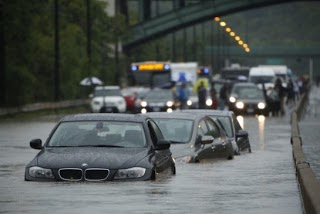
“We’re struggling to keep things like the TTC up and running and hospitals up and running,” Haines said on CP24 in Toronto. The July 8, 2013 storm ranks as the most costly natural disaster in the province's history, resulting in over 850 million dollars in property damage, according to CBC news. Despite this, not much effort has been made to deal with the infrastructural problems that led to the extensive flooding that caused the bulk of the damage


Although some question the effectiveness of sewage and drainage system upgrades, believing that they'll only serve to increase the already enormous debt held by the city, they can help to alleviate future flood damage as well as improve the functionality of the city during intense storms. Improving Toronto’s drainage and sewage system infrastructure would prevent home and road flooding, resulting in lower water damage costs as well as smoother transportation in the city.


The record breaking downfall of rain caused major sewerage lines to be backed up which resulted in thousands of flooded basements. By July 26, 2013, about 4500 calls had been made to Toronto Water regarding flooded basements. 

“Tanya Morgado, who commutes from Mississauga, Ont., to downtown Toronto, chose to focus on her flooded basement instead of trying to make her way into work. When the 25-year-old got home on Monday night, she ran downstairs — in the dark due to a loss of power — to find muddy water seeping in and rising at an alarming rate. At its highest point, Morgado estimated about 45 centimetres of water covered her carpeted basement floors, rising higher than the electric sockets in the walls.” – National Post.


Currently, according to the Huffington Post, insurers warned that consumer’s insurance bill may rise due to the 850 million dollars in damage as a consequence, strengthening the sewerage system would save people lots of money seeing that home damage would be reduced.


The intense flooding caused by the storm resulted in the closure of many roads and highways, including the Don Valley Parkway. In addition, approximately 1400 GO transit passengers were stuck in the trains for seven hours before being rescued. Moreover, sinkholes were created from the heavy downpour, creating further complications for travelling. CBC news reports that it could cost 8 million dollars for a city to repair all its sinkholes from flooding. Therefore, fixing sewers would not only save money in the future, but it will save people time on their commute and ensure their safety in intense storms.


Although there are numerous solutions, the most straightforward and effective choice would be to simply bring back underground rivers. These underground rivers are designed to relieve stress on the drainage in times on high water traffic. Yet, this idea is outdated and clearly cannot manage the heavy precipitation as shown from July 2013. 


Michael Cook, a graduate student in landscape architecture at the University of Toronto who has been exploring sewer systems around the GTA for the past decade, is championing an idea to ease the strain on the storm sewer system: prevent rain from entering the sewers in the first place. “One way to do this,” he said, “is to restore buried rivers and creeks, a practice known as ‘daylighting’ that is gaining traction in cities around the world.”- The Globe and Mail. Daylighting will not only help to alleviate stress from the sewage and drainage systems, it will also make Toronto a more environmentally friendly city. This system has also been demonstrated to work in other major cities around the world. When the city of Seoul spent 384 million dollars to restored six kilometres of the Cheonggyecheon stream, air and noise pollution were reduced and birds, fish and insect came back to the area.


Spending over 900 million dollars to improve Toronto’s infrastructure, specifically focusing on drainage and sewage systems would be ideal to Torontonians. Using the money to repair the city and to introduce daylighting would reduce home and road damage in future storms. Commuting during storms will be more efficient, not as many basements would be affected by flooding and the city will become more eco-friendly. Overall, this investment will strengthen Toronto for the future.

Wednesday, 18 September 2013

The Next Step in Human Evolution

 by Daniel Qi Writing grade 9-10 class
  
Every one in six thousand five hundred babies are born with a serious mitochondrial disorder. This common issue, a DNA defect in the mitochondria (which causes many chronic diseases), can be solved through genetic engineering. Human genetic engineering is the key to the future of human evolution as children can be genetically engineered to save siblings from fatal diseases, modified to be more intelligent and have stronger immune systems, and most importantly, family related illnesses such as mitochondrial defects can be eliminated.         
           
There are babies who are referred to as the "saviour sibling". These are children who are genetically engineered to provide matching tissues to help cure an elder sibling who is ill. For instance, Zain Hashmi, a six-year-old boy with a fatal genetic blood disorder, who's only chance is a bone marrow transplant from a common blood type sibling. His mother's eggs were tested to find one that is suitable to save Zain. His new baby brother saved Zain's life and his parents were grateful. Not all cases however have a happy ending. Many people argue about the ethical issues of "saviour siblings". On the other hand, the pros of this type of genetic modification out weighs the cons. Many fatal and chronic diseases can be greatly slowed or cured entirely.
           
Even healthy children can benefit from this technology through the testing of the mother's eggs for the best child. Many diseases can be screened not to happen in the first place, in a process called IVF-ET (In Vitro Fertilization and Embryo Transfer). Parents can select a child that will not contract a family related illness such as heart disease. Children may be selected for physical traits such as eye or hair colour. The most important idea is that children can be selected to have a strong immunity to disease and become very intelligent. Every parent wants the best for their child and this would allow them to give their child a more happy life. Some people say it's not safe to allow the practice right now and they are right. Selective traits are practiced on animals to make sure there would be no issues later in humans.
           
One type of genetic engineering already proven to be possible is the mitochondrial transfer. This practice essentially allows for a three parent child, where the mother's defective mitochondrial DNA is replaced with DNA from a donor. In late April of this year, it was confirmed that the team at the Institute for Reproductive Medicine and Science of St. Barnabas has successfully produced 30 babies through this process. These transfers allow the parents to avoid passing these genetic defects to their child. Common mitochondrial diseases may cause diabetes, degeneration of nerves, or even blindness. Once the cause of the disease is found to be a mitochondrial genetic disorder it's too late, the child would have to live with the disease forever as the DNA is locked in their cells. 

This process has been tested to work on macaque monkeys; in 2009, Dr. Mitalipov and his researchers took eggs from two different populations (one from India, another from China). They transferred a foreign nucleus to the egg. The experiment's results were ground breaking; the infant monkeys were completely healthy even with DNA from two different populations of monkeys. "The monkey model is useful in understanding the early embryonic development, where the monkey can stand in for the human," says DR. Behringer a geneticist at MD Anderson Cancer Center. Although yet to be proven to work with humans, it will most likely work in the near future.
           
In the end, genetic defects plague the human population and this is the best solution for now. Genetic engineering is important to our evolutionary future, the fatal diseases we have can be cured and future generations can be genetically modified to be superior to humans today. The world is a harsh place and humans are far from perfect. With genetic defects that are fatal, our best solution is staring us in the face. Our technology is now almost to the point where we can control the course of our evolution, so why should we pass on a chance to improve ourselves?